
The Beginner's guide to shore fishing
By Simon Day.

Want to learn how to fish the sea but don't know where to begin?
These pages cover the real basics of sea fishing for beginners. Think of page 1 as a dummies guide to sea fishing.
Getting started
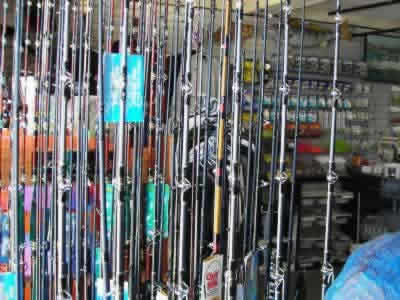
It can feel like a minefield out there with new products coming out almost daily. Do you need most of this to start off? No you don't!
There is no point spending a fortune if you've never done it before because you may not enjoy it. Many places do a really cheap combo deals for a rod and reel. This is what you may want to buy to start off with.
The cheap combo rod will probably only last you a few months and the reel maybe a bit longer. The thing is you do really need to spend a decent chunk of money straight off if you may not enjoy it?
The equipment you'll need
I have a check list which I look at every single time I'm about to leave. I won't forget something if I use the checklist!
For a normal trip out you will need:
- Your rod and reel
- Your tackle
- Your bait
- A sharp knife
- A bucket to keep your catches in (recommended)
- A cloth to wipe your hands and hold spiky fish
- Spare spool of line for making rigs etc.
- Small first aid kit
- A small (but long-nosed) plier or disgorger
So let's look at some of the equipment you'll need in a bit more detail…
Buying a fishing reel
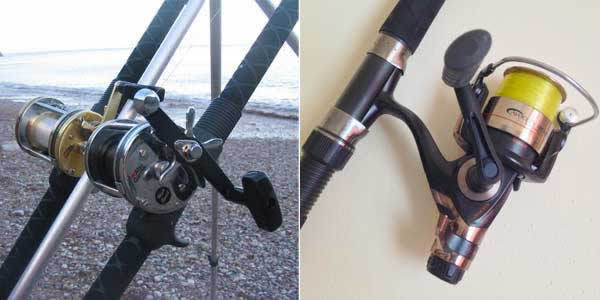
Multiplier (left) and fixed spool reel (right)
The two main types of reels are multipliers (left on image above) and fixed spool (right on image above).
Multipliers can be quite troublesome for a beginner because they can birds-nest. This means the lines gets all tangled up in itself and it can take quite a while to untangle. This can happen as you cast and as the weight hits the water. This doesn't happen with fixed spool reels so for an absolute beginner the fixed spool reel is 'always' the best choice.
I'll break down the main differences between the two types anyway:
Multiplier
- Can be better at casting longer distances
- Better when using heavy lines
- Better at fighting bigger fish
- Better at rough ground fishing
- Not good with lighter lines (can birds-nests)
- Not as easy to use in the dark
- Very unforgiving on casting errors
Fixed Spool
- Better with lighter lines
- Best at forgiving casting errors
- Good for night fishing and sandy-bottom fishing
- Better for floats, feathering and spinning
- Not as good with heavy lines
- Not as good with difficult grounds
- Not as good bringing in big fish
- Not as good for distance casting
What line to put on your reel
Opinions will vary a LOT on which line type to put on and what line strength to use. Here are some general suggestions...
While a braid line can be useful in some cases for shore fishing, putting a mono line on your spool will be the better choice for all-round sea fishing.
The average fisherman will use no more than a 10lb to 15lb line but you need to check the instructions that come with your reel to see what they advise is best for the reel you purchased.
If you're buying a multiplier reel then check the reel for the recommended line to put on as it can vary for each one. Also make sure you have a strong leader and the join knot is at the side of your reel BEFORE you cast to stop it cutting your thumb when you cast.
Buying a fishing rod
Before you start you need to decide what type of fishing you'll be doing the 'most' of.
The most common options are:
- Float fishing
- Spinning
- Feathering
- Fishing on the seabed
- Fishing in rocks
- Fishing from cliffs
- Fishing from the beach
Have a think about what type of fishing you'd like to do before you go and make your purchases. If you have a local tackle shop go in and ask them. If you're buying online check reviews. More on buying online further down this page.
Shore rods come in many sizes from 6ft to 15ft and depending on where and what you fish depends on the size of the rod you need to buy.
If you are going to be mostly spinning and float fishing then a 7-9ft spinning rod will be perfectly fine for both. You could also use it for feathering but I wouldn't recommend you use more than 3 feathers as the strain of bringing up, say 6 big mackerel on 6 feathers can break the rings (or rod) on light spinning and other light rods. If you don't understand what 3 to 6 feathers means click here (opens a new tab).
I use a 9 foot spinning rod for feathering (3 feathers), spinning and float fishing. If shoals of mackerel are around I'll switch to a stiffer beachcaster rod, stronger reel and put 6 feathers on it.
As to the reason why I use a light spinning rod and small reel when I feather is simple; the weight of the rod and reel is negligible so my arms don't ache after a short period of time. If you use heavy gear you'll arms will soon tire. Once I know the fish are there in numbers I switch to the heavier rod/reel set-up because I'll only be casting a few times before I have enough mackerel for a family dinner that evening.
If you're going to be doing a lot of feathering and spinning I also wouldn't recommend a telescopic rod because they tend to be quite a bit heavier than a normal rod.
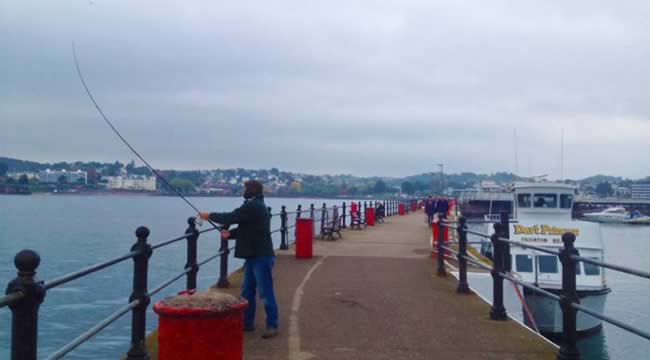
Something else that's worth thinking of is how much bend is in the rod. If you're on cliffs and piers you may need a stiffer rod to haul that fish up with more ease. It's slightly harder to detect bites if you're fishing the bottom but it makes no difference if you're feathering, float fishing or spinning.
To be honest though, it isn't much of an issue most of the time. My daughter has a dirt cheap £20 rod/reel combo and the rod bends all the way down but she can still pier fish and land a couple of mackerel on feathers.
What about those 12-15ft beachcaster rods?
I only use a large beachcaster rod with a decent multiplier reel when I'm fishing the seabed (especially when I'm fishing rocky seabeds!). You can hook some pretty big fish when you're fishing the bottom so you need a stronger set-up to handle big fish and rough terrain.
If you're buying your gear online
If you don't have a local tackle shop and you're buying online then you must check the reviews! Don't buy anything without properly researching it. The most important things you need to know are...
- How heavy is the rod/reel?
- How much bend does the rod have?
- What weight can the rod/reel handle?
- How sturdy is it made?
- What type of fishing was it being used for?
- What kind of sea-bed can it handle?
[ Back to Top ]
Best time to shore fish
This all depends on the type of fish you're going after. Dawn and dusk are usually pretty good all round times, with dawn being the better of the two (I can hear your groans from here at the thought of you getting up before dawn hehehe). For daytime fishing a rising tide and high tide are usually the best times for most fish.
On a new moon and full moon you have that day plus another three days after which are the highest tides of that month. Many types of fish like the higher water so fishing on those days can be the most productive.
It's important to note that this isn't always the case. Bass, as an example, can often favour the lower building tides before a new moon or full moon. Some fish prefer hunting on a low tide and as the tide is turning. If you know the fish you're after I would suggest asking a local tackle shop or forum. All I can give you is the general best times for most types of fish.
The tackle
Always make sure you have at least two of what you're going to need because Murphy's law always kicks in at the worst times :)
I would also advise keeping bait in a box or bucket (half filled with sea water) for two reasons:
- It keeps it out of the sun
- Seagulls can't swoop down and grab your bait or catches.
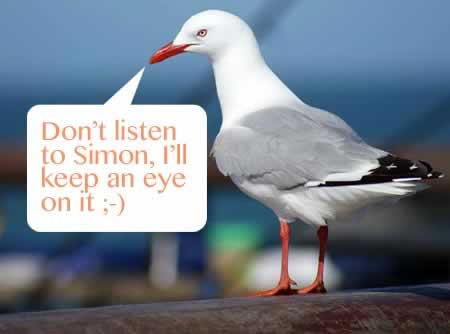
Do not trust that seagull, it lies! :)
Fish dry out quickly on hot, sunny days but keeping them in a bucket of sea water virtually eliminates this! I would never go fishing for fish like mackerel without one, ever!
Try to find out what kind of seabed you'll be fishing in and use a fishing rig appropriate to that seabed.
Float fishing is simple because you can buy float fishing kits. Just be aware that the sets can be poorer quality compared to buying the pieces separately. These sets should have a diagram on how to set it up but I also have a photo guide to setting up a float here.
What should my tackle box include?
When you first start your stocking up, a good list of things to buy should include:
- 2 or more floats (plus weights for them)
- 2 or 3 different sets of hooks
- 6 or more various weights (see below)
- A long nosed plier or disgorger
- Small and large beads
- A sharp knife
- Packet of swivels
- Bait elastic
- Spare line
I've now added a new page called 'What should go inside my fishing tackle box' (opens a new tab) Which gives you more details on all the list above.
What fishing weights do I need?
Weights will depend of the type of fishing you'll be doing. For calm waters with no strong tides a 2oz or 3oz weight should be fine for feathering and maybe even bottom fishing. For rough seas, strong currents or when you're casting in-between rocks and do not want any drift a 4oz or more is a better option.
If you're rough ground fishing then I'd suggest buying some breakaway weights. You stand much less chance of them snagging in rocky ground:
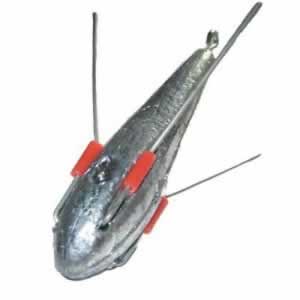
A breakaway weight
I don't know how many others do this but I sometimes also use the breakaway weights above on sandy-ground. They behave like a anchor and stop the weight from moving (especially in stronger moving currents).
Fishing floats come in all shapes and sizes so you do need to get the right weight for the right float. It isn't possible to say which one it is as there is way too much variation. Each float in a shop or online should tell you what weight you need for it.
[ Back to Top ]
What hooks to buy
Hooks are something that confuses many people and it is vital you get the right ones for where you fish.
Bigger hooks do not mean bigger fish!
If you have satellite TV watch the lake fishing programmes like the ones Matt Hayes is on you'll see monster fish caught on the smallest of hooks. Bigger hooks are only useful if you're only going for the big fish and don't want little ones hooking up (when fishing for Conger for example).
This doesn't always work but you do limit the smaller fish. The hook lengths are designed for the type of bait you might be using.
For mackerel strips the length of the hook doesn't need to be long. The longer length shanks on hooks are designed for worms like rag which you feed up the length of the shank (more on bait later).
Again tell the shop what type of fishing you'll be doing and what do they recommend. Never be afraid or embarrassed to take up their time because they get dozens and dozens of people every day asking the same things. If you don't ask then don't expect the best results when you go fishing.
Circle hooks are becoming very popular because they virtually eliminate the need to strike. These hooks are designed to hook the fish as they take the bait. This is the hook I'm using more and more when I'm out fishing and I really like them.
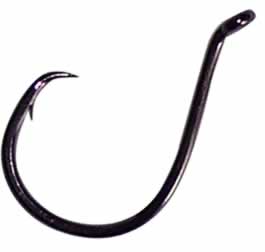
A circle hook virtually eliminates striking.
[ Back to Top ]
How to tell if you've hooked a fish
The best way to tell is to tighten the line and raise your rod straight up and hold it there... just like this...
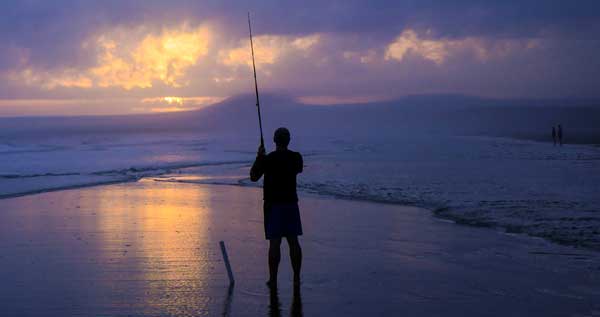
If you have a fish on you will feel it fighting the hook and pulling at your line. If, as an exmaple, you're snagged, it won't move at all.
Beach Fishing - Tripods
For beach fishing it is worth investing in a tripod for your rod(s). These tripods are often only used for the rods but they do have other uses that many don't realise.
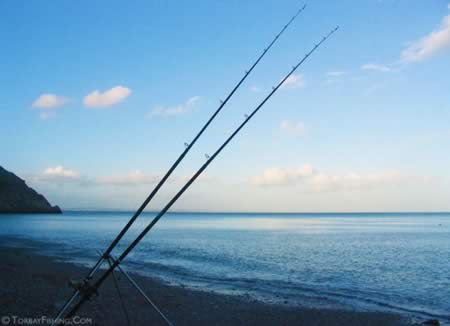
Some tripods have extending legs and I prefer these because I can attach things to the tripod and still have a good clearance from the ground. Once I have both rods out I start using the downtime to make more rigs while I wait for a bite. As I finish a rig I'll hook it onto my extending tripod. This keeps it off the beach (and away from hooking dogs) and it is then ready to go should I need a quick change of rigs.
Sometimes these tripods have a hook in the middle so I use that to hold a bucket or bag which contains the bait. Again it keeps it off the beach and away from dogs and seagulls. It also gives the tripod a bit more stability and weight.
[ Back to Top ]
First aid kit
It doesn't have to be a huge great thing but common sense would say make sure you include waterproof plasters for grazes and other small cuts, sterile dressings for bad cuts (due to a knife slip for example) and some kind of cleaning agent. In the summer it would be a good idea to carry some sun cream as well.
Beginners Guide » Page 2 (Baits)
Help support this site!
If you value the information on this site then please help support me with the large running costs.
Recent Donations, thank you! £5.00
If this page didn't help you please, please, please email me here and tell me what you wanted on this page. I can add whatever it is you think was missing!
Beginner's guide to sea fishing
Also see - Common fishing knots (videos)
- How to tie a lock blood knot (Popular)
- How to tie a clinch knot (Popular)
- How to tie an Albright fishing knot to join two lines together.
Latest guides added
- How to fish from a pier
- How to unhook swallowed hooks
- South West fishing seasons - what you'll catch
- How to catch Mackerel using lures, feathers & floats
- How to catch cod
Also see...
- Fishing training in Torbay, Devon.
- How to set up fishing rigs
- Sea fishing seasons
- How to set-up a float for fishing
- How to tie a clinch knot (commonly used)
- How to tie a lock blood knot (commonly used)
- How to tie an Albright fishing knot to join two lines together.
Am I missing something? Please contact me to suggest an addition to these guides. Help me to help you!
All these pages are copyrighted and you do not have permission to copy and display this work in any form. You may print these pages out if they are for your reading only. If you have your own website permission is only granted to link to these pages.